DeHavilland DHC-2 Beaver
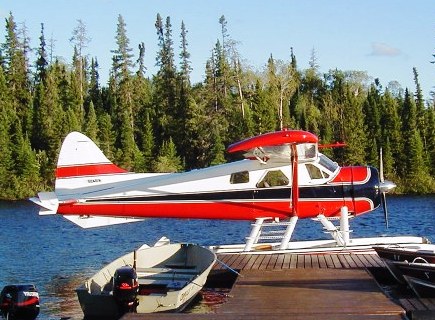
Mentioning the deHavilland Beaver often invokes a religious like reaction amongst die-hard bush pilots. Pilots have been known to take their hats off when one flies over and old-timers have become misty-eyed in remembrance of times past that they had with the deHavilland. With a stout nine cylinder Pratt & Whitney radial, Beavers fly over emitting a roar evocative of steep mountains, unruly bears and true wilderness. The deHavilland Beaver can be fitted with floats or skis. The Beaver features an aluminum, semi-monocoque design.

If a person is ambivalent about the Beaver when he or she initially approaches one, such ambivalence quickly evaporates when they sees the cockpit. The deHavilland Beaver was designed as a serious, no-nonsense bush plane and this philosophy is well reflected in its functional, though rugged cockpit. The Beaver is not a dainty little airplane that appeals to nair-do-wells. It is a large barrel-chested plane that looks quite capable of eating Cessnas and Super Cubs as mere snacks. As further evidence of the rugged functionality of the Beaver, its oil filler spout and dipstick are located in the cockpit itself. It is possible to add oil to the engine with one hand while flying the Beaver with the other (though not particularly recommended). Many of these aircraft were built for the Unites States military, and it is common to see Beavers with functional, though very spartan interiors. Tube frame seats and web fabric, such as featured in military airplanes, are often seen in Beavers. Other Beavers have been lavishly restored and have interiors rivaling those of luxury cars.

The deHavilland Beaver was first flown in August 1947 and was produced commercially until 1967. 1657 Beavers were made, and as a tribute to the plane’s bush ability, many of these are still flying to this day. Viking Air of Victoria, Canada, owns the production rights to many of the older deHavilland aircraft (including the Beaver), but currently there are no plans to return the plane to production.
Prices of used Beavers tend to be steep and well refurbished planes often have prices in excess of $500,000. Even wrecked and non-flying rebuildable projects regularly commend prices in the low six-figure range.
Kenmore Air of Kenmore, Washington specializes in refurbishing Beavers and “Kenmore Beavers” are often advertised in used airplane publications. Kenmore holds numerous STC modifications for the Beaver.
Beavers are typically powered by an R-985 Pratt & Whitney radial engine. Some have been modified to accept turbo-prop engines, though these Beavers are relatively rare. The Pratt & Whitney radial is a very reliable engine and produces 450 hp in stock form on the Beaver.
Beavers have large cabins and can seat eight people. Depending upon equipment, their useful load can be 2,100 pounds, which is close to the gross weight of most Super Cubs. On floats, Beavers seem to take on gigantic dimensions, particularly when one takes a view from the cockpit.
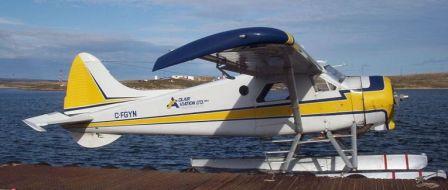
The deHavilland Beaver does not offer the outstanding short field performance of Super Cubs or Helios, but this is not surprising when one considers its size. Nevertheless, Beavers are respectable short-field aircraft, with take-off and landing distances roughly comparable to the Cessna 180s and 185s. Beavers will cruise at speeds approaching 140 mph depending upon how they are equipped and pilot technique.
Start your Beaver! Enjoy this cockpit view of a cold Beaver start-up using the wobble pump to pressurize the fuel lines.
Here are two short videos we thought you would enjoy. The first one is a cockpit view of a DeHavilland Beaver flying over a more rural harbor (beautiful landscape) and the second one shows a deHavilland Beaver riding on the back of a forklift, which is something you don't see everyday.
The next video features a DeHavilland Beaver float plane from the Beluga Lake Float Plane Service in Homer, Alaska, taxiing for takeoff in McNeil Cove while a brown bear walks the beach at the McNeil River Bear Sanctuary in southwest Alaska.
Wes Head, pilot and owner of Beluga Air in Homer, Alaska wrote in to let us know that was his green Beaver behind the bear at McNeil Cove although the former owner was piloting the plane at the time of the video. Wes says the Beaver is the best bush plane for float work but the Cessna 206 is the best bush plane "For flying the villages, and wheel work, beaches, gravel bars, etc. - with loads it is the 206 hands down".
We checked out Beluga Air and what a cool operation! They do flight-seeing, guided bear tours, charters, weddings, you name it. If you are planning a trip to Alaska, definitely check them out. There is some really good information on their website: http://belugaair.com/services/
For those who haven't experienced Alaska firsthand, grab some popcorn and watch this next video.It features a cockpit view of a float equipped Beaver flying from the Kenai Pennisula to Johnstone Bay where you can watch an aerial view of snow-covered mountains, glaciers, boats on the water, lots of trees and blue sky. You can almost smell the fresh air.... Enjoy!
Here is a short video clip of a 1956 DeHavilland Beaver landing in Victoria Harbor, British Columbia, Canada. The harbor is beautiful and the weather couldn't be better....
Beaver Fantasies
Graeme Herbert, from Canada, who has been flying for over 47 years wrote in to tell us the DeHavilland Beaver was both his dream plane and the best bush plane.
Mark Helseth, from the United States, who has been flying for 8 years, wrote in to tell us the Beaver was his dream plane. Doug, also from the U.S., who has been flying since 1951, agrees hands down. He was referred to bush-planes.com from piston engine princess (aka Laura Marxen) who also voted the Beaver as her favorite. If you have not visited Laura's website - its a must see, especially if you love dogs as much as we do.
Others voting in favor of the Beaver are Nate from Canada, Zdravko from Croatia and Dave May from Colorado, who still can't decide between the Beaver and the Norseman.
Dave No. 2, also from the United States, who has only flown on a flight simulator claims the Beaver as the best bush plane but can't decide whether his dream plane is the Beaver or the Super Cub.
Brad, a private pilot from the U.S., can't decide if his dream plane is a Beaver or a Mooney. When asked his dream plane, he says, "Two planes: a Mooney Acclaim S for my love of speed and a DHC2 Beaver for my love of a machine approaching perfection to the job it is designed for." Brad is an interesting guy and we found his self-description so compelling we had to include it here, "Brand spanking new Private Pilot Certificate student at age 56. Grew up an airplane nut which I inherited from my dad, an Army Air Corp officer beginning in WWII B-25's. He did a little CAP and recreational flying as an Air Force Major after the war, but gave it up when I was born because of tight money responsibilities in raising a family, Rabid model builder as a boy with dad. Had planes suspended on wires across the ceiling of my bedroom, Rode my bike and was a hanger rat at Lovell Field - Chattanooga, TN. Read anything the library had on planes." Does this remind you of anyone you know? Perhaps someone who lives at your address?
Kevin Cogan, another private pilot from the U.S., can't decide whether his dream plane is a Pitts S-2 homebuilt or a Grumman Goose or Widgeon, but he definitely had an opinion about the best bush plane, "Asking what the best bush plane is, is like asking weather a Chevy is better than a Ford. Ask it in a bar and you will likely start a fight. Express an opinion and you will get your ass kicked and start a fight. Knowing this, I nominate the Beaver for it's pedigree and radial engine." Thanks Kevin. Fight the good fight....
Seems like there are a lot of folks out there getting misty-eyed over the Beaver. Do you agree? Vote for your favorite bush plane here.
Casting Call for Canadian Aviators
We received an email requesting information for a television show. Here it is:
I am a TV producer starting work on a series about aviation in Canada. I part I am working on is about bush pilots. I would like to know if you could help me figure out where, within Canada, people are flying today. I am also wonderin if there are any events coming up before next spring that we might be able to shoot - Thnak you - my phone number is * (toronto)
If anyone has information to share about Canadian flying events with the possibility of getting on television, please respond here and we will pass all serious information along to the producer. Once the show is published, we hope to share that information here on this website.
 Blink
Blink Del.icio.us
 Digg
Digg Furl
Furl Google
 Simpy
Simpy Spurl
Spurl Technorati
 Y! MyWeb