Cessna 206
What do you get if you stretch a 182 and put two more seats in it? Well when Cessna did it they got the 205 which soon became the 206 and which sometime later, became a plane that can be heard all over bush country. 206s are not the ideal bush plane (they're a little underpowered for as large as they are) and they have the bush hating tri-gear. Even though the 206 does not match the ideal design for a bush plane, it is common in bush country because it does so many things so well and it lacks any real competition.
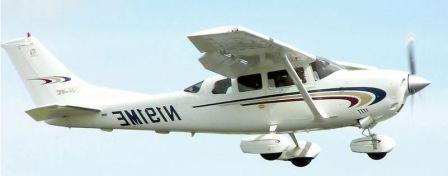
The 206 was manufactured for years with a Continental IO-520 engine that produced 285 to 300 hp depending upon the particular model (205s are rare and only had 260 hp). It was offered with factory turbocharging on some models and was produced from 1962 (as the 205) until 1986. Cessna re-introduced the 206 in 1998 and switched engines to Lycomings that produced 300 hp. The re-introduced plane is still in production. Although the back seats are somewhat cramped, the 206 can haul six adults easily and it is this load carrying capacity that has made the 206 common in bush country. 206s can be fitted with floats.
206s are decent flying planes and are very stable. Their controls are a bit heavier than many planes, but they are by no means difficult to fly. Construction is semi-monocoque aluminum, much as the Cessna 180s and 185s.
The 206 will cruise at 150 mph (faster with turbocharging) and are decent short field performers, though they are not nearly as spritely as 180/185s and certainly nowhere near a Super Cub or Helio. 206s on floats seem to have to be coaxed into the air compared to float equipped 180/185s.
Cessna offered a stretched version of the 206 with two more seats known as the 207 or Stationair 7, but only 626 were produced. The back seats in these planes are very cramped. These planes are not common and few are privately owned. Most have led very busy life as commuter airliners and 207s with total flying times over 10,000 hours is common.
Soloy offers a turboprop conversion for the 205/206/207 series and these planes are fitted with an Allison turboprop. The engine produces 420 hp which alleviates some of the plane's lethargy, but these conversions are rare.
On balance the 206s were better six-seaters than 180/185s or Helios but, once again, they didn't have the bush performance of these airplanes.
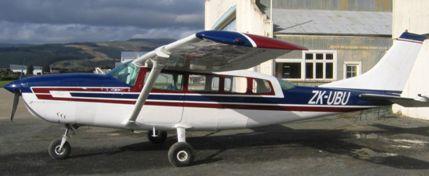
Incidently, the 207 ZK-UBU in the photo above comes courtesy of Brian Grant at the School of Surveying at the University of Otago in Dunedin, New Zealand. We've asked Brian to give us some history of his airplane to personalize the photo a bit and will post his response once we hear back from him.
Danielle from Botswana, a pilot since 1992, wrote in about her impressions of the Cessna 206. She said, "Lovely C206 page with seemingly "real" aircraft descriptions, i.e outlined the problems I've experienced or witnessed with C206s in bush strips, operating on charter for many years in Africa (very different to Alaska/Canada, but we do like to think Africa has quite a bit of bush too!). Just to confirm that bush pilots, although perhaps the adventures still romantic and some of the participants may retain the nostalgic stereotypical images, the days of "kick the tyres and go" bush pilots are long gone. This in mind I'd like to know if you're interested in reviewing our C206 Training Manual - as far as I know, it's the only one written for this plane. Well anyway, I like your site, nicely written and will do a write up about it in my blog soon as I get a chance."
Thanks, Danielle. We took a look at a sample of the Cessna 206 training manual and give it a thumb's up. If you need a training manual on the Cessna 206, take a look at this.
Alaskan pilot, Patrick Pragman, felt the 207 was a good choice for best bush plane (some of the time), "In terms of performance probably a Cub, in terms of practicality probably a 207. 207s are everywhere in west alaska, and can carry a hell of a load. I'd definitely say that there are more than "a few" of them flying for "commuter" operators. They are ubiquitous in Bethel, and I fly them in Kodiak. They show up in Kotz, and on the north slope. Hell, they're even in Juneau."
Do you agree? Rant and rave about your favorite bush plane here.
Or, instead, relax and watch the next video which features a Cessna 206 taking off from a lake in the Katmai National Perserve in Alaska.
Cessna 206 Fan Club
Sven from Tanzania says the 206 is his dream plane and the best bush plane based on his experience. He said, "I can only speak from experience with Cessna aircraft, but the 206s we had with IO550, four-point harnesses, STOL kit, large tyres, fortified Frames and inside struts were certainly good Tools for the Job, which was to ship passengers and cargo and do the odd camera or Survey flight."
Sven was also kind enough to send in a Cessna 206 flight video which has some great cockpit views over the Mahale National Park on the shore of Lake Tanganyikain in Tazmania. Thanks, Sven, the video was really nice and we have posted it here to share with the rest of the Cessna 206 fans.
What is the Best Bush Plane?
Do you have a great story, an opinion, a tip or a review about this plane? Share it!
 Blink
Blink Del.icio.us
 Digg
Digg Furl
Furl Google
 Simpy
Simpy Spurl
Spurl Technorati
 Y! MyWeb